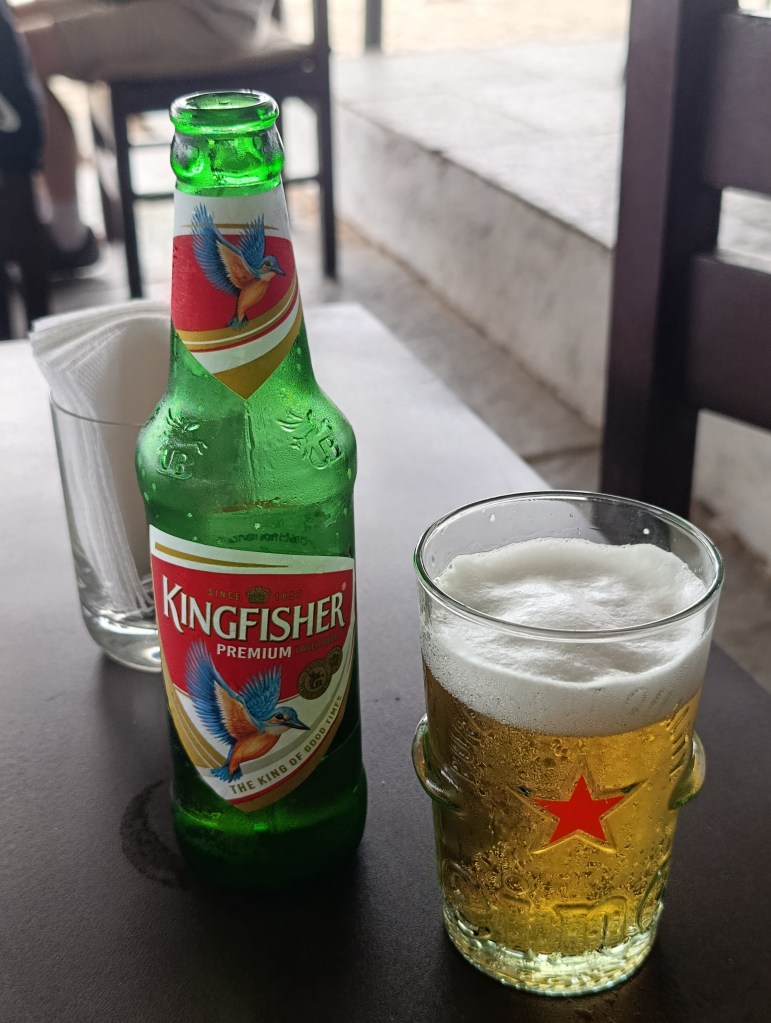
Great slip-proof glass from Heiniken, I believe. It is so humid here that the beer glasses are always wet outside.
Inertia seems to rule on this trip. I’m not thrilled with Colva Beach, but I’ve got a comfortable spot to live and am learning where to eat, buy the necessities, get things done… and today was GET SOME CASH day! In Panaji after having my card rejected in several bank’s ATMs and swallowed by one, complete with flashing lights and shrieking noises, I learned that the State Bank of India happily accepts Visa cards.

My hotel.
Informing the management of my financial distress, the head man at the hotel offered to drive me to the nearest SBI branch with an ATM. Turned out this small branch had a broken ATM, and when I mentioned to the manager that ‘No Money means No Money!’ we hastened to the surprisingly large and bustling big city of Margao. He had brought along a helper, who was reading google maps and phoning the bank offices as we got hopelessly lost.
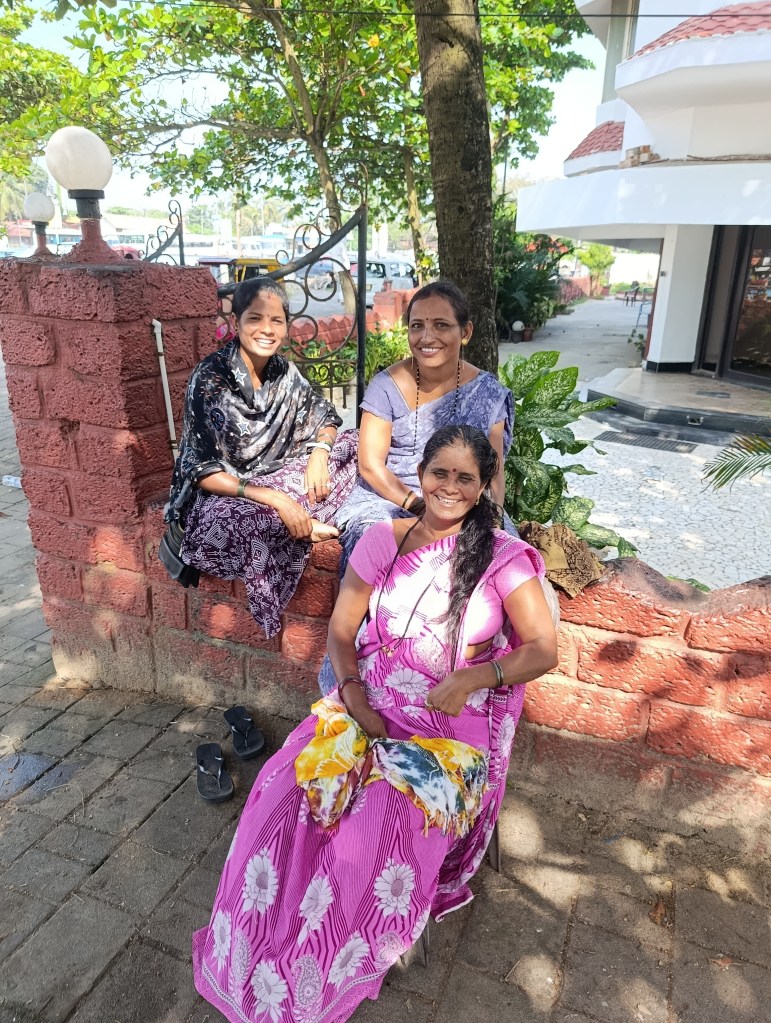
Street vendors taking a break in Colva.
Things got desperate as he resorted to asking passers-by for directions. Finally I spotted a State bank on a random street and we were set.
Next up… Air Pollution. Noticing for a number of days that we had not seen the blue sky or any clouds, I checked the Colva Air Quality Index… 90, POOR. Here we are on the shore of the Arabian Sea, with an onshore breeze all day long and the sky resembles New England during Canadian wildfire season. There are no sunsets, just a hazy ball sinking into the ocean.

It is lush. Found an article, below.
‘All of nine India’s geographically diverse regions showed an overall annual decline in sunshine hours, though the rate of decrease varied across India. Monthly analysis revealed significant increases from October to May, followed by sharp drops from June to July in six of the nine regions.
This seasonal pattern of sunshine intersects with a deeper, long-standing problem: India’s severe air pollution crisis – it’s now among the world’s top 10 polluted countries – which scientists trace back to the 1990s. Rapid urbanisation, industrial growth and land-use changes drove up fossil fuel use, vehicle emissions and biomass burning, sending aerosols into the atmosphere and dimming the Sun’s rays.’
I first bicycled in India in 1985, and indeed, spent time on the beaches of Goa. At that time, the road traffic consisted of 6-ton trucks with 35 mph governors on their speed, busses and white Indian made Ambassador cars driven by government officials. Traffic was sparse and slow and most people rode bicycles or walked. India relies primarily on coal for energy, because that’s what they have. And the Goa beaches?

My friend Peter, a German, at Palolem Beach just a bit south of here in 2011. Aging hippies living in beach shacks 6 months a year. I lived sleeping on beaches in Hawaii for over a year in the early 1970’s. Time marches on…
 Ni Dieu Ni Maitre